


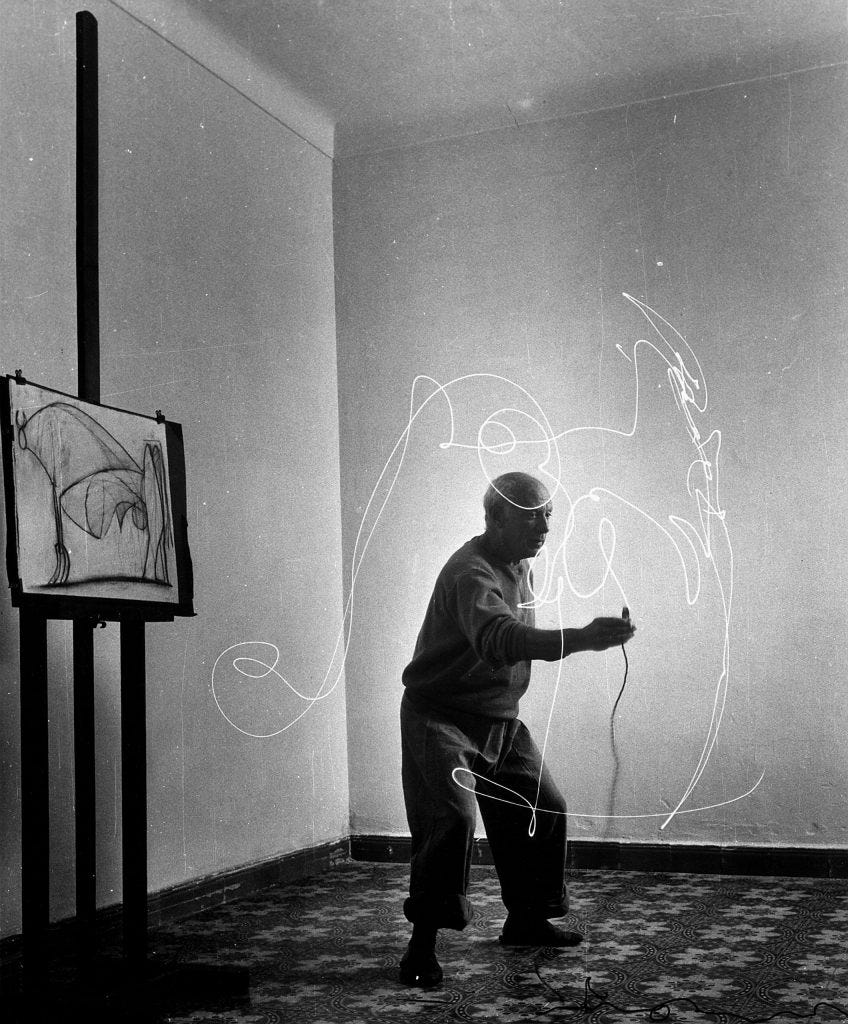
Venture capital is built around a simple premise: find something that works and make more of it. The assumption is straightforward. If a product, service, or business creates value, expanding its reach should create even more. In many industries, this logic works remarkably well. Yet some of the most meaningful forms of value operate according to a fundamentally different principle.
Art doesn’t scale.
At first glance, this sounds like a limitation. In reality, it may be one of its greatest strengths.
What gives art its value is often precisely what makes it difficult to replicate: personality, perspective, craftsmanship, human expression, and a distinct point of view. These qualities cannot easily be systemized, outsourced, or expanded across thousands of locations. They are deeply connected to the individuals who create them.
This tension extends far beyond art itself. It appears in restaurants, fashion brands, hospitality concepts, creative studios, and increasingly in many of the companies shaping contemporary culture. The moment something becomes successful, the natural instinct is expansion. More stores, more markets, more products, more customers. Growth becomes the objective.
The challenge is that scale and cultural value do not always move in the same direction.
Nowhere is this tension more visible than in luxury. Many luxury brands sell exclusivity while simultaneously pursuing global reach. The promise is scarcity, craftsmanship, and uniqueness, while the business strategy often revolves around reaching larger audiences and expanding distribution. At a certain point, those two ambitions begin to conflict. If something is available everywhere, what exactly remains exclusive?
This may help explain why niche brands feel particularly relevant today. As products become easier to manufacture, distribute, and replicate, people increasingly search for qualities that cannot be copied so easily. A clear point of view. A founder’s taste. A visible human presence behind the product. In many cases, what people value is not scale itself but the evidence that someone cared enough to create something distinctive.
Perhaps this is one of the reasons I have always been drawn to Japanese craftsmanship. Across generations, craftspeople continue to dedicate decades to mastering a single discipline, whether ceramics, woodworking, textiles, or knife making. The objective is rarely rapid expansion but refinement. The goal is not to produce more, but to produce better.
Many of these workshops will never become global businesses. Yet their influence often extends far beyond their size. Their value comes from patience, mastery, and an understanding that certain forms of excellence require time. A master ceramicist cannot compress twenty years of experience into two. An artist cannot outsource perspective. A great restaurant cannot automate hospitality.
This is not an argument against scale. It is an argument for being more deliberate about what we choose to scale in the first place.
For decades, scale has been treated as the default measure of success. Bigger audiences, greater reach, and larger businesses were assumed to represent progress. Increasingly, however, culture seems to be moving in another direction. People are drawn to depth, craftsmanship, community, and experiences that feel personal rather than optimized.
The real opportunity may lie not only in knowing how to scale, but in understanding what should remain intentionally human. Because some of the most valuable things in culture derive their value from the very fact that they cannot be infinitely replicated.
Curated Notes
A selection of conversations, products, ideas, and cultural moments that caught my attention recently.
Loved listening to Nick Hayek speak about craftsmanship, manufacturing, and building enduring brands in an increasingly digital world.
Jeff Magid’s reflections on why art galleries don’t scale resonated with many of the themes explored throughout this essay.
Ferrari’s first fully electric vehicle, designed with Jony Ive’s LoveFrom studio, faced significant backlash, highlighting the challenges of extending heritage brands into new territory.
Adrian Zecha, the founder of Aman, launched a new farm resort in Japan, a project built around craftsmanship, local culture, and a slower, more intentional vision of luxury.
A Rothko sold for $85.8 million, one of the largest art sales of the year so far.
Louis Vuitton became the title partner of the Monaco Grand Prix, reflecting the growing convergence of luxury, sport, and entertainment.
An Ongoing Dialogue
Curated is an ongoing dialogue, a living system of ideas exploring design, technology, and culture through curiosity and conversation.
I’d love to hear from you, what’s been inspiring you lately, or what’s been shaping your sense of taste? Reply anytime or contact me directly via Instagram or LinkedIn.
Thanks for reading. If this resonates, feel free to forward it to someone who cares about design, technology, and culture as much as you do.